Maryna Pochynska
Founder and teacher at PolyPortal
On closed doors, the little blue friend Azulinho, the path from medicine to languages, and why Portuguese is a journey, not an exam.
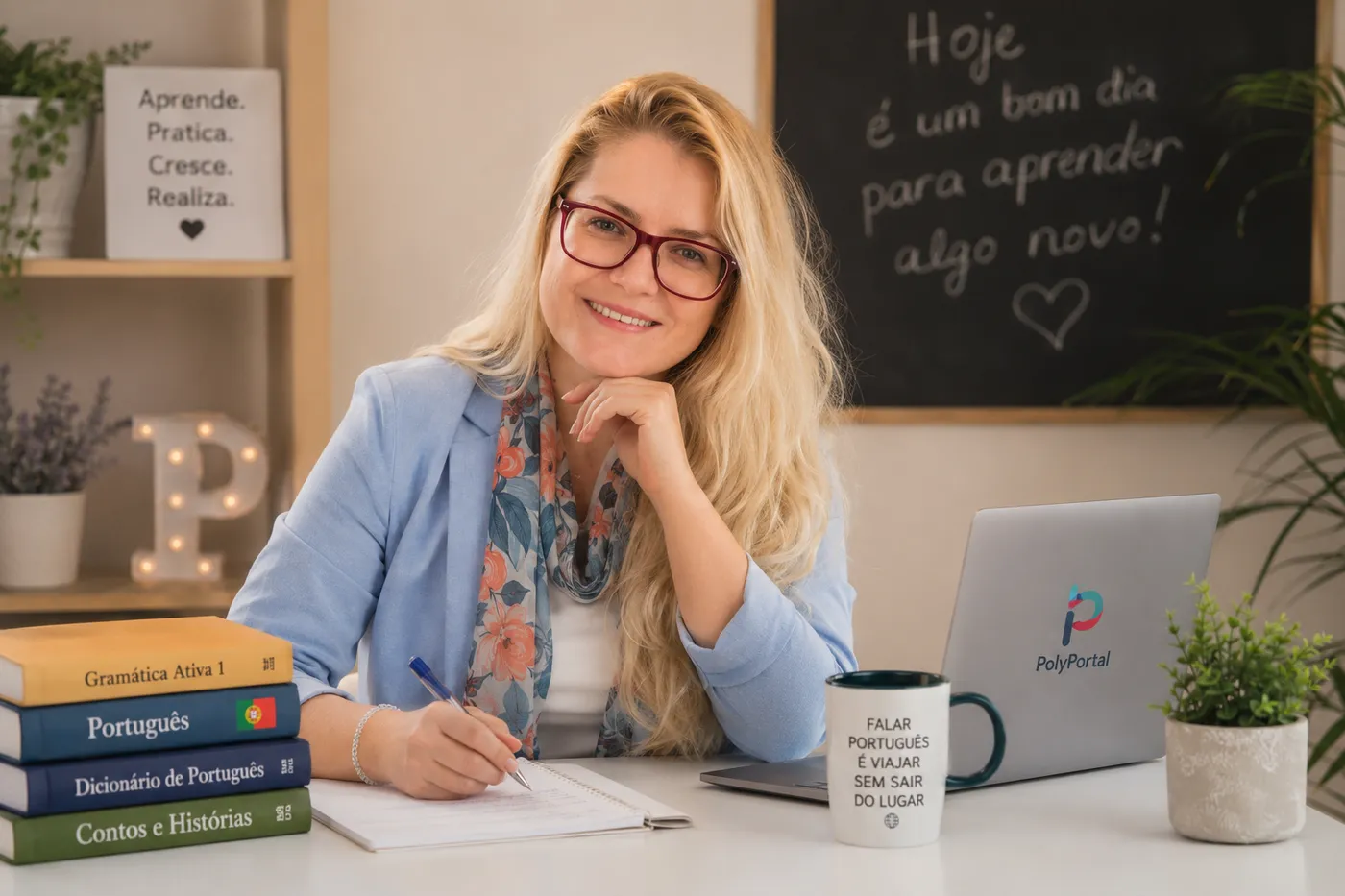
What PolyPortal is
What the name PolyPortal means
For a long time I stood in front of a closed door to the Portuguese language myself. I was looking for the key. Looking for an explanation. Looking for the logic.
And when I finally found it, the door opened. That was the moment I realised I wanted to help others open their own doors.
That is how the name PolyPortal was born.
“Poly” means plurality, diversity and the coming together of different directions, people, methods and possibilities.
“Portal” is an entrance, a passage, a door into a new space.
For me, PolyPortal is a space in which many doors exist.
For some it is a door into a new language.
For others — into a confident life in a new country.
For a child — into a better understanding of the school curriculum.
For an adult — into a new profession, travel, new connections or the fulfilment of a long-held dream.
Everyone learns differently.
Some need tables. Some need illustrations. Some take in information better by ear. Others need associations, interactive exercises, plenty of practice or a detailed, logical explanation.
There is no single right path for everyone.
Every person is unique, and for each one you have to find their own door.
That, for me, is the true meaning behind the name PolyPortal.
What is the core idea of PolyPortal?
I don’t want my students to simply memorise rules. I want them to understand what they are doing and why.
When a person sees the logic, a difficult topic stops feeling chaotic. They begin to notice the system, grow more confident and no longer fear mistakes so much.
For me, a lesson is not just the delivery of ready-made information. It is a shared exploration by student and teacher.
I keep learning too — searching for new explanations, exploring the Portuguese language, discovering it for myself and helping others fall in love with it. I want my students to feel that a language is not a set of dry rules.
A language is history, culture, the character of a people, a way of thinking and a whole new world.
And every new lesson begins, for me, with one central question: “How do I make sure a student not only understands the Portuguese language, but comes to love it?”
That is exactly why PolyPortal was born.
Every person is unique, and for each one you have to find their own door.
Azulinho — the blue friend
Who is this blue character in the pictures?
When I began creating my own lessons and learning materials, I wanted my students to have someone beside them who would make learning warmer, more alive and more engaging.
That is how Azulinho appeared.
His name comes from the Portuguese word “azul”, which means “blue”. And the suffix “-inho”, as my students know well, often gives a word a diminutive or affectionate meaning.
So Azulinho is a little blue friend who accompanies students in their learning, helps explain difficult topics, asks questions, offers support and reminds them there is no need to fear mistakes.
To me he is not just a character or a decoration on learning materials.
He is part of the world of PolyPortal.



Why is Azulinho blue?
Portugal sits on the edge of Europe and is inseparably tied to the Atlantic Ocean. So the colour blue came very naturally.
Blue is the ocean and the sky. It is depth, freedom, calm and trust.
At the same time it is the power of the waves — which can be quiet and gentle, or show incredible might.
For me this colour captures the character of Portugal very precisely: open to the world, strong, deep, yet at the same time calm, sincere and kind.
If you look closely at Azulinho, you can notice his wavy hair. It resembles the waves of the Atlantic Ocean that wash the Portuguese coast.
So Azulinho is connected not only to the word “azul”, but also to the image of Portugal itself — its nature, its history and its character.
Later he was joined by a friend — Azulinha. Together they help act out dialogues, explain new words and grammar topics, and create situations from everyday life.
They can support a student, ask a question, draw attention to an important rule or simply bring a smile.
I don’t believe that Azulinho and Azulinha were created only for children.
Adults, too, remember information better when it stirs emotion, association and interest.
Learning should not be dry and faceless.
Sometimes a small story or a familiar character helps ease the tension and bring a difficult topic closer.
That is why Azulinho and Azulinha are full members of the learning world of PolyPortal.
Who I am and where I come from
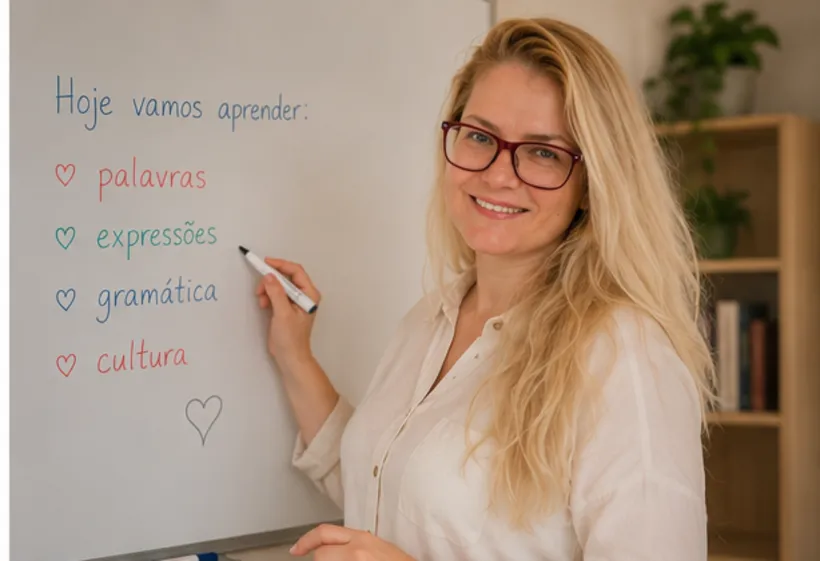
If we asked you to describe yourself in a few words, who are you above all?
First and foremost, I am a teacher.
That has been true for almost all of my adult life. I love to explore, to find patterns, to ask questions, to search for answers — and then to explain complex things in a way that makes them clear to others.
What I love most is seeing that special moment when something that only recently seemed hard, tangled or out of reach suddenly opens up before a person.
When understanding appears in a student’s eyes, I feel that my work has real meaning. That, perhaps, is my true calling.
Did you always want to be a teacher?
Actually, the first profession I chose for myself was medicine. But towards the end of my studies I was offered a position at the Department of Internal Medicine of V. N. Karazin Kharkiv National University. I accepted.
And that decision shaped my life.
I taught internal medicine to English-speaking students from all over the world. Every class was held in English. It wasn’t enough just to know medicine well — I also had to explain complex processes to people of different backgrounds, with different language experience and different ways of thinking.
That was when I finally realised how much I love not simply possessing knowledge, but passing it on to others.
But you were also involved in science?
Alongside teaching, I carried out research, took part in conferences, published academic papers and defended a PhD dissertation in cardiology.
Science taught me something very important: you have to ask questions, compare facts, test assumptions, look for causes and see the patterns.
It was never enough for me simply to know that a certain phenomenon exists. I wanted to understand why it arose, how it works and what it is connected to.
It was this research-minded approach that I later carried over into teaching languages.
Where does your love of teaching come from?
To a large extent, I think, from my grandfather.
He was a teacher too. It was my grandfather who instilled in me a respect for education, a love of knowledge, and showed me how important it is not just to know something yourself, but to help others learn.
He supported me in everything. When the idea of creating PolyPortal came to me, my grandfather was the first person I told about it.
He believed in me sincerely and always helped me nurture whatever I set out to do.
And I very much want a small part of his love for teaching to keep living on in what I create today.
When did foreign languages come into your life?
I loved languages from childhood.
I studied English with pleasure. It came to me fairly easily. Later, at university, I also studied Latin.
Latin gave me an understanding of the origin and structure of many words, medical and general scientific terms. English helped me recognise international vocabulary, linguistic links and certain grammatical patterns more quickly.
So at the beginning Portuguese came to me quite easily, and my vocabulary grew very fast.
How did you realise you wanted to move from teaching medicine to teaching languages?
It happened at a very unexpected time in my life. I was out of work then, and one day I happened upon a video. In it, a young woman was saying that Ukrainians are educated people who know how to think, analyse, learn and find solutions.
She suggested asking yourself a few simple but very important questions:
“What am I good at?”
“What truly matters to me?”
“What brings me joy?”
The answer came instantly. Without a shadow of doubt. Teaching.
I realised that teaching others is what I live for, what I love and what brings me immense joy. All that remained was to work out what exactly I wanted to teach. And the answer was just as obvious: languages. Because by teaching a language, I keep learning myself, develop my own knowledge and help others grow.
That, perhaps, is my true calling.
How I fell in love with Portuguese
Why Portuguese in particular?
Life brought me to Portugal. At first, like most people, I simply began learning the language of the country I had found myself in. But gradually Portuguese became far more to me than just a means of communication.
I love this language boundlessly.
It seems to me extraordinarily interesting, deep and alive. I love exploring its structure, the meaning of words, the origin of expressions, the peculiarities of its grammar and pronunciation.
Portuguese never stops surprising me.
In it, one ordinary word can carry a multitude of meanings. Its sense can shift depending on context, intonation or situation. An expression that seems neutral at first glance can turn out to be ironic, tender, playful or even offensive.
Perhaps the Portuguese people themselves shaped your feelings towards the language?
Absolutely. For me, a language is inseparable from the people who speak it.
Perhaps I came to love Portuguese so much precisely thanks to the Lusitanians — their openness, sincerity, kindness and readiness to help.
In this language I feel the character of the people and of the country itself.
Sometimes it feels as though I treat Portuguese almost like a child — with tenderness, awe and a desire to keep discovering something new in it.
Portugal is a country with an incredible past. A country of seafarers and explorers who were not afraid to set out into the unknown.
I am amazed by the Portuguese discoveries, the historic voyages and the way a small country on the edge of Europe managed to leave such a visible mark on world history.
I love feeling that behind every word stands the history of a people.
The Portuguese language crossed oceans and became part of people’s lives on different continents.
Perhaps, just as Portuguese seafarers once discovered new lands, I discover new depths of this language every day. And I want to help others make these discoveries too.
To grow Portuguese within myself and pass it on to others — with love, respect and awe.
How did your own learning of Portuguese go?
At first I studied with teachers. I attended various courses, studied at private schools and took one-to-one lessons.
I had many teachers. Some changed because courses came to an end. With others I stopped because I lacked depth in the explanations. On the surface everything was going well. I learned new words, did the exercises, took in the rules. But inside there was a constant feeling that something was not right.
As if a wall stood before me.
I could see the whole world of the Portuguese language behind it, but I couldn’t reach it. I learned the rules, but didn’t always understand why they worked the way they did. I memorised constructions, but couldn’t feel how they were connected to one another.
When I asked why one construction was correct and another was not, all I often heard was: “That’s just how it is.” Or: “It’s a rule, just memorise it.”
But those answers didn’t help me get past the wall. On the contrary, sometimes it seemed to grow even higher. I felt there had to be a key somewhere that would open the door to a real understanding of the language.
But I just couldn’t find it.
What helped you get past that wall?
At a certain point I realised that I wanted to learn Portuguese far more deeply than ordinary courses could offer.
And so I began studying on my own.
I bought dictionaries, reference books, textbooks. My home library filled up with books very quickly. I read, analysed, compared different sources, looked for patterns and tried to understand how the language really works.
I already knew the rules, but it mattered to me to understand WHY they exist. Why this way and not another. Why one construction works in a certain situation and another does not.
Gradually the separate rules began to come together into a single system. What had once seemed chaotic began to take on logic. And one day I realised I had found the very key I had been searching for so long.
The key that opened the door to a real understanding of the Portuguese language.
That was when I stopped simply learning Portuguese.
I started living it.
And it was probably then that the future idea of PolyPortal was born.
Was that when your approach to teaching changed?
Yes. When I had walked that path myself, I understood one very important thing.
Most people are not afraid of languages. They are afraid of the moment when they stop understanding something.
When that same wall rises up before them again. I remember that feeling very well.
I don’t want to just say: “That’s correct.” I want to give a person the key, to show the logic. To explain it so that the rule stops being a rule and becomes clear.
Because when a person understands, the fear disappears.
I started living it.
My approach to teaching
They say native speakers sometimes find it hard to explain the rules of their language. Do you agree with that?
That’s true. Because for them it is a native language. The Portuguese absorb it naturally from birth. They feel how to say something correctly, but they can’t always explain the logic behind their linguistic intuition.
In the same way, we sometimes can’t immediately explain a certain phenomenon in our own native language to a foreigner. We simply know that “it sounds right.”
But for someone learning a non-native language, that is often not enough. They need a system. They need to see the connection between the rules, understand the reason and learn to use their knowledge in new situations.
I believe we shouldn’t limit ourselves to mechanically memorising ready-made phrases.
Of course, everyone learns differently. Some find it easier to remember examples, others need tables, diagrams, associations, illustrations or plenty of practice.
That is exactly why a teacher has to look for different approaches to each student.
Why do you create so many of your own materials?
Because I know myself how hard it is to find material that truly explains.
When I worked at a language school, I wasn’t very happy that most lessons were taught from ready-made textbooks. I wanted to explain things differently. So I began creating my own lectures.
Tables.
Diagrams.
Visual notes.
Interactive exercises.
Original dictionaries.
Materials for children and adults.
Explanations of school grammar.
Maths in Portuguese. The history of Portugal.
And all of it grew out of just one question: “How can I explain this more simply?”
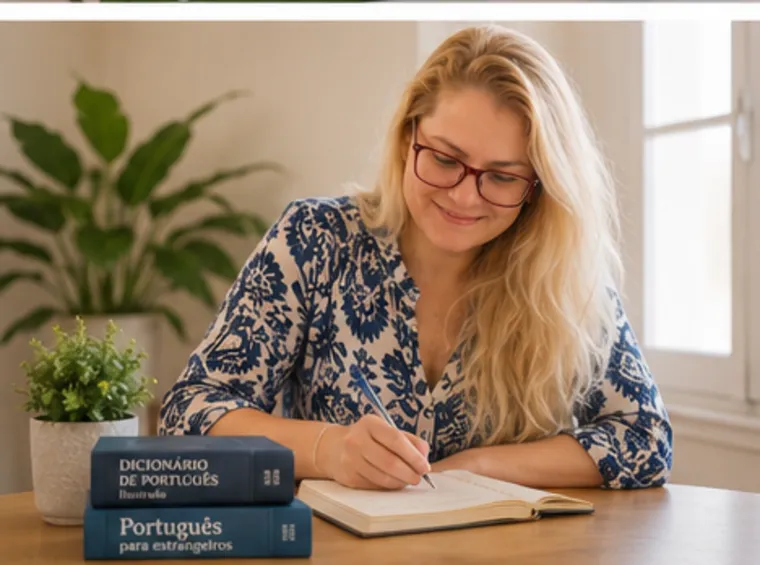
Who was your first student?
This is a very special story for me. When I decided to work on my own, my first student was a boy who at the time was not even living in Portugal yet. We started studying before his move. So he arrived in Portugal already with a certain foundation in the language.
Several years have passed, and he still keeps studying with me.
I watched him adapt, develop, grow up and improve his Portuguese. It is a great joy for me to follow not only his progress in the language, but also the way he is growing as a person.
I am very proud of him.
And it was this boy who, at the age of twelve, helped build the PolyPortal website. For me that is incredibly symbolic. I helped him learn Portuguese, and he helped me take an important step towards making my dream come true.
I am very grateful to him for this work.
And all of it grew out of just one question: “How can I explain this more simply?”
A language is a journey
What advice would you give to someone who is just starting to learn a language?
First of all — don’t be afraid.
I really want people to stop seeing language learning as hard labour, endless memorising of rules or a constant struggle with mistakes. Try to look at it differently.
Imagine that you are setting off on a long-awaited journey.
When we travel to a new country, we don’t get upset that we don’t know anything about it yet. On the contrary — that is exactly what makes the journey exciting.
We read about the place we’re heading to in advance. We look at photos and videos. We search for interesting routes. We ask friends what’s worth seeing. We put together our own list of places we want to visit.
And when we arrive, we wander with delight through the narrow streets of Lisbon, climb the mountains of Gerês, stand on the shore of the Atlantic Ocean, step into ancient monasteries, admire the azulejos, read the street names, study the monuments and slowly discover the country’s history for ourselves.
I really want people to treat a language the same way.
Be curious.
Look for answers.
Take an interest in where words come from.
Marvel at unusual expressions.
Notice how the Portuguese speak.
Don’t be afraid to make mistakes.
Because every new word is one more little discovery. Every grammatical tense is one more path. Every expression opens up a small piece of the culture, the history and the way a people thinks.
Don’t think about how much there is still to learn. Better to look back and see how much you have already discovered.
A language is not a marathon or an exam. It is a journey that can last a lifetime. And that, perhaps, is its greatest beauty.
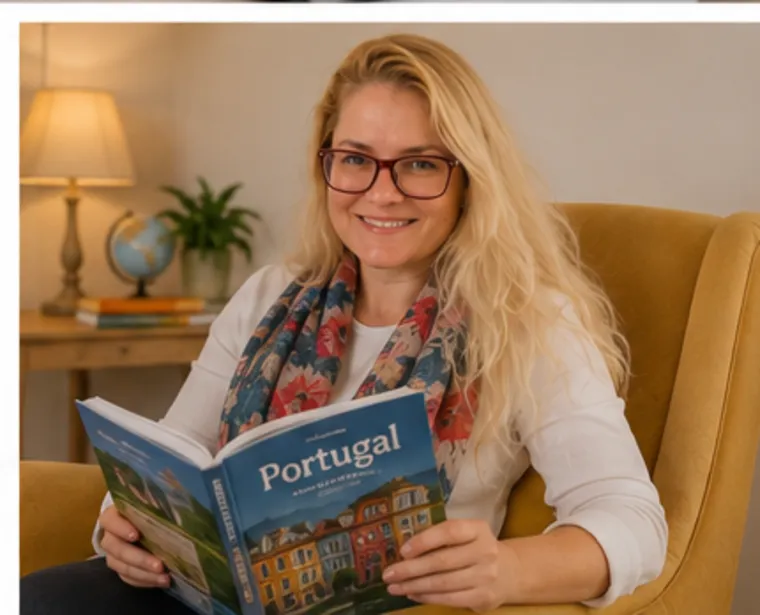
What is the hardest part of being a teacher for you?
Saying goodbye.
That, I think, is the hardest part. Especially with children.
Some study with me for many years. Together we start with the very first words. Together we go through the difficulties. Together we celebrate the successes.
Over that time I grow attached to each child and begin to sense their character. I understand when to encourage, when to joke, when to praise, when to give more independence.
Every student is special.
When the lessons come to an end, I always feel a little sad. As if a whole story is ending. As if the child has grown up, become independent and no longer needs my help.
On one hand, that is exactly what every teacher wants. It means the person has learned. On the other hand, letting go is never easy.
That is why I rejoice so sincerely in my students’ successes. And I feel very sad when our shared story comes to an end.
Can Portuguese ever be fully learned?
Honestly? I think not. And that is exactly what I love about it.
A language is alive.
It changes constantly. New words appear. Old words take on new meanings. Sometimes one and the same word can mean dozens of different things depending on the situation. And sometimes an ordinary word suddenly becomes part of a set expression that can no longer be understood literally.
That is why learning a language lasts a lifetime. And I love that very much. I still discover something for myself almost every day.
I think that is one of the most beautiful things about being a teacher — we never stop being students ourselves. We are constantly exploring, reading, analysing, discovering something new. And that means our mind keeps working, developing and staying curious.
It seems to me that it is precisely this curiosity about the world that helps a person stay young — no matter their age.
Why do you teach European Portuguese specifically?
The European and Brazilian varieties of Portuguese are very close, but there are noticeable differences between them in pronunciation, vocabulary and grammar. Sometimes even identical words can have different meanings or be used in different situations.
In practice I often see the same picture. A new student comes to their first lesson and starts reading the phrase “boa noite”. From the pronunciation alone I can tell that they previously used an online translator or materials with Brazilian audio.
When I ask about it, students are surprised: “How did you know?”
The reason is simple: there is far more freely available material in Brazilian Portuguese. A person may not even realise which variety of the language they have started learning. It matters to me that people who live in Portugal or plan to move here hear European pronunciation from the very start, learn current vocabulary and understand the language spoken around them.
That is why all PolyPortal materials are built on the European variety of Portuguese.
Is that how your dictionaries came about?
Yes. When I started teaching, I quickly realised that there is far less good, modern and at the same time clear material specifically in European Portuguese than one would like. Especially the kind that doesn’t just give a translation of a word, but helps you understand it, hear it and remember it.
That is why I began creating my own dictionaries.
It mattered to me that a person shouldn’t just read a new word. They should hear its correct European pronunciation. See a clear illustration. Link the word to a concrete image. And only then remember it naturally, without mechanical cramming.
After all, the more senses take part in learning, the more easily the information stays in memory. And so a whole library of original materials gradually began to take shape — one that I keep adding to.
Today it comprises 38 thematic dictionaries and 32 dictionaries for fairy tales and stories.
A special place belongs to the dictionaries for fairy tales. We often read familiar stories in Portuguese.
When a person already knows the plot in their native language, it is far easier for them to focus not on translating every word, but on the Portuguese language itself.
Before reading, a student can look through the dictionary, listen to the pronunciation, study the illustrations and prepare the necessary vocabulary. Then, during the lesson, they no longer stop at every unfamiliar word but read the text far more confidently, and begin to notice grammatical constructions, expressions and the features of a living language.
What is especially dear to me is that my son took part in creating some of them.
It is his voice that narrates part of the dictionaries. I love the thought that PolyPortal has become for us not only my project, but also a small family endeavour, into which each of us has put a piece of our soul.
I like to believe that each such dictionary is more than just a list of words.
It is one more little door into the world of the Portuguese language.
And perhaps it is precisely these doors that will help someone take the next step on their own great journey.
What would you like to say to the people reading this interview right now?
Thank you. Thank you for walking this path together with me.
Perhaps, after this conversation, you understand a little better not only me, but also why PolyPortal is the way it is.
It was not born as a business. Nor even as a school.
PolyPortal was born out of a great love of knowledge, of teaching and of the Portuguese language.
And if one day our paths cross — in a lesson, in a dictionary or simply on the pages of this website — I will be very glad to help you take one more step on your own journey.
Welcome to PolyPortal.
Start speaking Português today!
The first step is simply to reach out. Together we’ll find a convenient time and a programme just for you.